
After we have explored the more technical part…now on to the fun part:
What garments were worn?
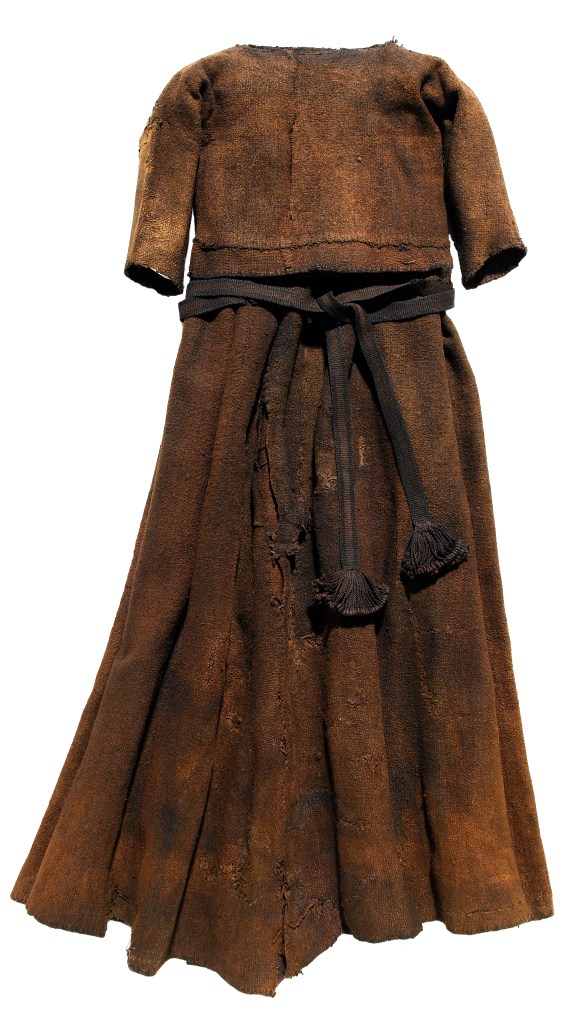
by L. Larsen, CC-BY-SA-2.5
Well, we don’t really know. Since no complete garment has survived from the Bronze Age we have to work with analogies and the most contemporaneous evidence available to us. The most common “go to” place for the latter are the beautifully preserved inhumation burials from the Northern Hemisphere, most noteably the individuals from Borum Eshøj, the Egtved Girl, and the woman from Skrydstrup. These women lived during the Early Nordic Bronze Age. The Egtved Girl’s coffin tree was cut around 1370 BCE, the Borum Eshoji burials date around 1351 to1345 BCE and a 14C date for the Skrydstrup woman indicates her death at around 1300 BCE. All these women wore a “blouse” made from one rectangular piece of fabric, which was sophisticatedly cut and then sewn together (construction-wise that makes it a poncho, which is the term used in the literature). Apart from the short string and bronze tube skirt from Egtved the others wore long tubular woven skirts with a diameter of around 3m, belted at the waist with a woven ribbon/belt. It is noteworthy that the woman from Skrydstrup also had another large garment, which was not found in-situ and as sparked some debate on its way of wear (Hald 1980).
There is only one “problem” with this general style…it is around 200-250 years off of my target time (and the location is off, too). Whilst pre-industrial fashion generally evolves at a slower rate and usually bases new styles on re-draping or re-cutting the fabrics used in the current one with as little waste as possible, 200 years is a long time. To be a bit cynical for a worst case scenario, it would mean wearing a Regency gown to the grocery store and claiming this is the current height of fashion. In my case, one way of almost solving the time problem would be, to wear only the earliest Urnfield Culture material. That would make Skrydstrup contemporaneous and the others almost fitting as the earliest phase of the Urnfield Culture is currently dated around 1330/1320 BCE.

wearing a chiton over a tunic as well as a himation (the “mantel” like piece on top)
British Museum, by M-L. Nguyen, public domain
But there is a large BUT: a) accessories and b) universality of certain styles. The latter also emerges from a style’s simplicity. Skirts and simple tops as well as simple rectangle based dresses can be combined with almost everything and there is evidence for them across many cultures and through time. Further, aside from a sewn shift-like dress, there are also possibilities which require no sewing at all. At the forefront would be a chiton, a style in Europe most prominently known from Ancient Greece. Essentially it is a large rectangle of fabric that is secured at one or both shoulders. If tubular weaving is practised (or one does one seam to fashion the rectangle into a tube), fastening this tube at the shoulders (often with some overhang) will create a peplos, a staple of Roman (and problably Central European Iron Age) fashion.
Until a dress from any target time and location is found, whatever style one chooses is an interpretation (the garment itself will always be one too, because we approximate the process based on current knowledge). Meaning in this time and locations, it is not the cut and style of the textile that makes it a specific period but the artefacts that you choose to wear with it. As people from the Urnfield Culture horizon preferred to cremate their dead, the existing inhumation burials are a valuable source on the way specific pieces of metal were worn. One of these cemeteries, Grunfeld (Germany), has gifted us the one “garment like” line of evidence that is actually from the right time and place. It is the impression of a woman’s somewhat closely fitting dress in sand as well as corroded pieces of fabric on the various metal artefacts. Although any garment can be laid close to the legs of a deceased person, a shift/tunic or a skirt bottom part are are the most likely options. Bronze discs preserved parts of a reinforced belt with beautifully woven ends, further the top garment likely possessed a collar (or detached choker) to which some bronze tubes were stitched (Bartel & Voss 2005). Singular needles are commonly found in the upper chest area of adults, often near the person’s right shoulder.
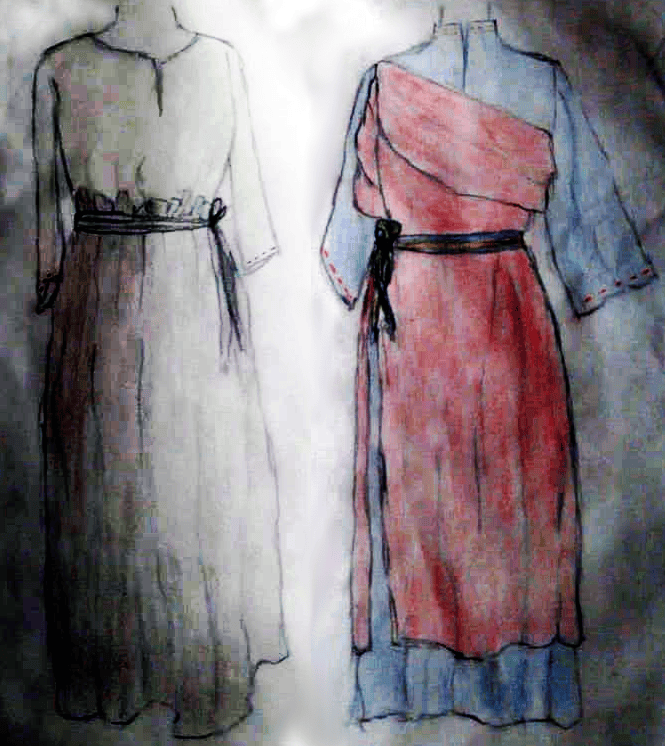
by C. Girotto 2020, CC BY-SA 3.0
Grömer et al. 2013 pointed out that there are many options and none is clearly the one and only. I decided to go with two different styles, preferably in such a manner that they could be mixed and combined (e.g. for winter months) – the “Nordic one” and a “chiton style with a collared tunic”. A chiton can be made with as little as 170 cm “circumference” (less is possible but then a full undergarment is advantageous), therefore allowing the fabric to lay close to the body whilst still providing enough room to walk comfortably. Whilst we do not know if that was a priority, it certainly seems that way based on the circumferences that we know from the North. Obviously the blouse can go with either skirt or chiton.
Some additional considerations…
Length
Some Urnfield Culture ladies wore shin guard like bronze plates on their lower legs, indicating a skirt that would have exposed them. They are rare and generally considered a prestigious item, so most likely one would like to show that off (although they produce very noticeable clanking while walking, so …). Especially the sound was not my gem, so I decided around ankle length would be nice.
Fabric
The fabrics: First, one has to decide how close they should resemble the ones preserved. Essentially, for me (and many others) this is a budget question, because it would be possible to get all of them woven for you, with the accurate thread counts and sizes. Whilst it is perfectly reasonable to do that for specific pieces (like if you wanted to add a shoulder blanket) or everything I decided I could not do that. To me, what screams “machine woven” more than anything, even from a large distance, is the selvage and regularity of the weave (and the drape, depending on material and density). Also, most modern fabrics are made from fine threads. Luckily, felted wool was very common in the Bronze Age and on it the effects are a lot less noticeably (if you purchase one that was originally woven and then felted, if it was knitted, the drape will differ). Whilst coarse and a bit irregular woollen fabrics can be found, linen fabrics pose the greatest problem. Handwoven linens are extremely dense, even when they were made out of very fine threads. This affects their drape (a lot) and the needles found in the graves are almost impossible to poke though without damaging the weave permanently (yay to experimental archaeology!)
Further, the selvage is visible on the poncho style blouses. Whilst this is also true for the skirt and chiton (which would be “made to measure” and therefore preferably had a selvage on each side) I thought a machine woven fabric would not do for the blouse. Generally, I am against cutting up antique fabrics/laces etc. but for this endeavour I purchased some turn of the century “peasants linen”. It can be bought in metres from the bolt (or even by the bolt), was never fashioned into any garment and therefore has little explanatory significance. I argued a lot with myself and the fact, that I am basically destroying archaeological evidence. In the end I decided that buying a bit more than two meters to make a reconstruction to teach people about archaeology might be a worthy cause (Spoiler alert: I still felt guilty when I was cutting it up).
So…what did I get?
Aside from the aforementioned linen, this will be a part of the construction posts. As one of the garments is finished at the time of me writing this post and the other requires dying some fabric, I will split the two styles but the ideas are outlined in the sketches 😉
– Chiara
Literature
Bartel & Voss 2005
Bartel A., Voss, H. Modisch in der Urnenfelderzeit: Zur Kleidung einer Frau aus Grundfeld. Das Archäologische Jahr in Bayern 2005, 44-46.
Grömer et al. 2013
Grömer K., Rösel-Mautendorfer H., Bender Joergensen L. Visions of Dress: Recreating Bronze Age Clothing from the Danubian Region. Textile – The Journal of Cloth and Culture 11:3 (2013), 218-241.
Hald 1980
Hald M. 1980 Ancient Danish Textiles from Bogs and Burials. A Comparative Study of Costume and Iron Age Textiles, The National Museum of Denmark XI, Copenhagen.


Leave a Reply