
Please allow me to take you along on my personal journey to reconstruct clothing for a Central European Urnfield Culture (1250 – 800 BCE) lady. Obviously I am not the first person to do this and I am most grateful for my friends at „aurea-aetas – Projekt Urnenfelderkultur/ Bronzezeit Lebendige Geschichte“ who not only introduced me to the field of living history but also informed parts of the process. This is by no means a complete review on Bronze Age textiles in Central Europe or a conclusive literature guide. I am not a textile researcher, so it foremost highlights were my research took me and how it informed my project. There is always more than one way to reach an interpretation and others have followed relatively the same path and reconstructed different styles from it. Due to the quite technical nature of this first entry, I apologise for the lack of pictures in advance! Please do check out the cited publications for images of the original archaeological textiles mentioned, the majority can be found on academia.com and other relevant services.
Therefore this series is intended to showcase the process of thought and research, as well as the making of such attire. The goal is to create clothing that is functional with the personal adornments recovered from graves whilst embracing the little textile evidence that has survived. Whilst textiles generally have little chance of survival due to their organic nature, the predominant burial custom of the time – cremation – certainly complicates the matter. There is extensive literature on the history of textiles, textile production, their evolution and chances of survival from the Neolithic to the Metal Ages (e.g. Grömer 2009, Grömer et al., 2010, Sabatini & Bergerbrant 2019) as well as research which garments known from archaeology or pictorial evidence were most likely worn (Grömer et al. 2013) so I will not go into detail and shortly summarise the most relevant aspects. As there is no complete garment or even a large piece of fabric with clear function surviving the predominate concern of textile research are threat counts, thickness, coverage factors, weave patterns and starting borders, weaving techniques, materials (plant vs animal), stitches, seams, (functional) embroidery, dyes, and their context of recovery. Usually it is not from a grave, more often charred or waterlogged settlement remains and of course, the salt mine of Hallstatt (Austria).
Hallstatt, the site after most of the Urnfield Culture (Hallstatt A and Hallstatt B) as well as the Early Iron Age (Hallstatt C and D) are named, provides evidence to what people brought into the mine and used there until it wore out completely
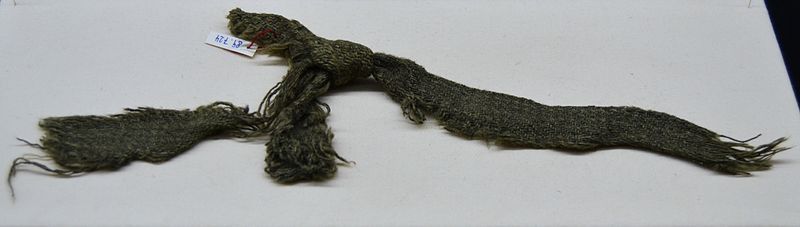
by Joanbanjo 2013, CC BY-SA 3.0
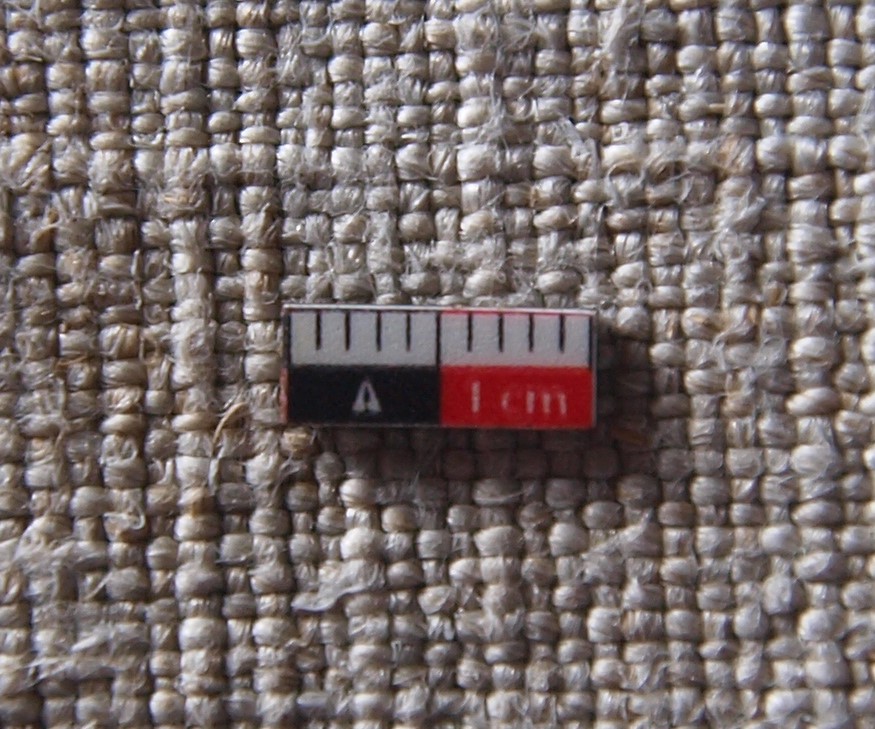
Almost all the pieces recovered from there show indications of recycling and secondary usage and a large portion of the Bronze Age fragments are most likely equipment. Amongst them is the oldest coloured two-hole tablet woven starting border (HallTex 288), featuring dark blue stripes on light wool (Grömer 2013). This technique is virtually indistinguishable from other band-weaving techniques unless the wrap-twined selvedge survives. Further, plaited woven borders as well as plaited with additional fringes are preserved. Most textiles were twill or tabby weaves, sometimes felted (e.g. HallTex 223), made predominantly from rather coarse threads (Grömer 2013).
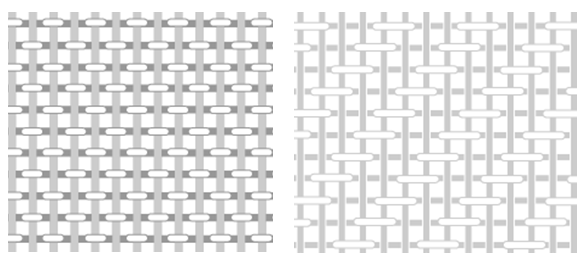
Both by Jauncourt 2007, CC BY-SA 3.0
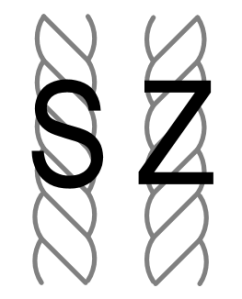
public domain
Further, fragments of panama woven fabric have been recovered from Urnfield Culture contexts (burial of Vössendorf, Grömer 2007 in Belanová-Štolcová, T. & Grömer 2010). The complex patterned weaves of the Iron Age are not yet in fashion. However, the alternating use of s- and z-spun yarns, as well as differently coloured weft and wrap threads (e.g. the twill from Damendorf, dated to ~ 950 – 720 BCE (Montelius V), Schablow 1976) are recorded.
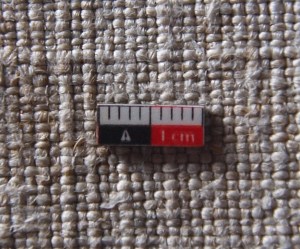
by C. Girotto 2020, CC BY-SA 3.0
At Hallstatt there are up to 10 threads per cm (usually around 6-7), with a high coverage factor, meaning the textiles were relatively dense. However, some textiles were quite loose, almost like veils or nets and rarely extremely fine yarns (~ 0.3 mm) were used (e.g. HallTex 211, Grömer 2013).
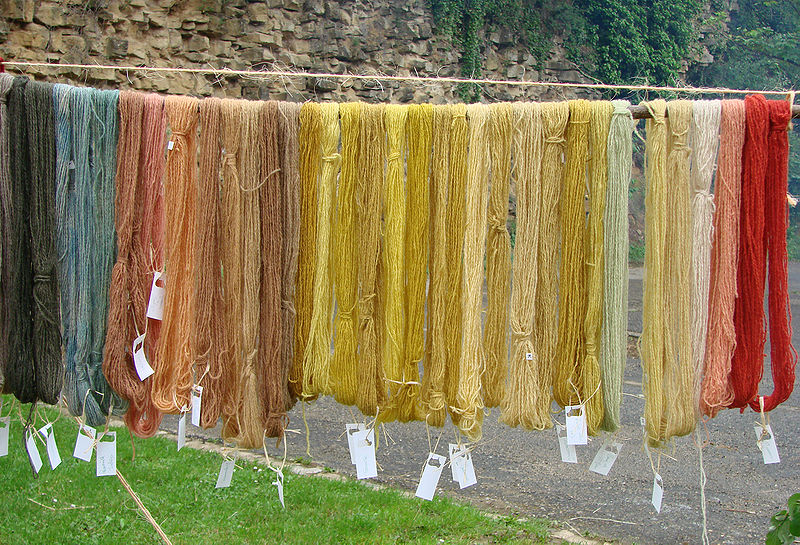
Contrary to Nordic Bronze Age there are quite a few examples of dyed fabrics, predominantly wool, for the Central European Bronze Age. Most modern analysis was conducted on the textiles recovered from Hallstatt, out of 12 analysed samples, 9 were definitely dyed. They have been preserved in a salty environment and some of them are still coloured to this day. Scientific analysis indicates the use of woad (blue), plants from the madder family (redish), and flavonoids (yellow).
public domain
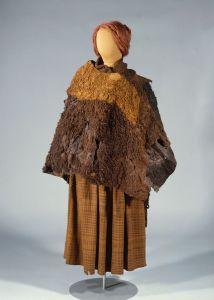
For the latter, purple gromwell has been suggested, as well as weld or saw-wort. Further, there is possible evidence for iron-gall black dying (Hofmann-de Keijzer et al. 2013). However, what we see today does not necessarily reflect the original, as pigments are quite prone to taphonomic decay. A good example would be the clothing of the woman from Huldremose, her clothing had been preserved in a bog, permanently altering the visual appearance to various brownish shades.
by Nationalmuseet, CC BY-SA 3.0
The original pattern of light and dark wool is still visible. However, the remnants of the original pigments could only be recovered by modern scientific analysis, highlighting that at least three different components (yellow, blue and an unidentified red tone) were used (Vanden Berghe et al. 2010). However, the techniques required to apply them makes it unlikely that all of them were used at the same time and indicates possibly some kind of over-dying. Therefore the original colour is hard to determine but blue or green have been suggested (Gelba & Mannering 2010).
After this rather lengthy but far from comprehensive summary, stay tuned for part II, where we explore what kind of garments these fabrics were most likely made in.
Literature:
Belanová-Štolcová, T. & Grömer 2010
Belanová-Štolcová T., – Grömer, K. Loom-weights, Spindles and Textiles. Textile Production in Central Europe from the Bronze Age to the Iron Age. In: Andersson Strand E., Gleba M., Mannering U., Munkholt C., Ringgaard M. (eds.), North European Symposium for Archaeological Textiles X. Ancient Textiles Series 5, 9-20 (Oxford 2010)
Gelba & Mannering 2010
Gelba M, Mannering U. A thread to the past: The Huldremose woman revisited. Archaeological Textiles Newsletter 50 (2010), 32-37.
Gömer 2007
Grömer K. Bronzezeitliche Gewebefunde aus Hallstatt. Ihr Kontext in der Textilkunde Mitteleuropas und die Entwicklung der Textiltechnologie zur Eisenzeit. Unpublished dissertation, University of Vienna (Vienna 2007)
Grömer 2009
Grömer K. Textilien der Bronzezeit in Mitteleuropa. Archäologia Austriaca 90, 2006 (Wien 2009), 31-72.
Grömer et al. 2010
Grömer K. Rösel-Mautendorfer H., Hofmann-de Keijzer R., Prähistorische Textilkunst in Mitteleuropa – Geschichte des Handwerks und der Kleidung vor den Römern (Vienna 2010)
Grömer 2013
Grömer K., Tradition, creativity and innovation – The development of textile expertise from the Bronze Age to the Hallstatt Period. In: Gömer K, Kern A, Reschreiter H., Rösel-Mautendorfer H. (eds.) Textiles from Hallstatt. Weaving culture in Brone Age and Iron Age salt mines. Archaeolingua 29, 53-98. (Budapest 2013).
Grömer et al. 2013
Grömer K., Rösel-Mautendorfer H., Bender Joergensen L. Visions of Dress: Recreating Bronze Age Clothing from the Danubian Region. Textile – The Journal of Cloth and Culture 11:3 (2013), 218-241.
Hofmann-de Keijzer et al. 2013
Hofmann-de Keijzer R., van Bommel M. R., Joosten, I., Hartl, A. , Néss Proaño Gaibor A., Heiss A. G., Kralofsky R., Erlach R., de Groot S., The colours and dyeing techniques of prehistoric textiles from the salt mines of Hallstatt. In: Gömer K, Kern A, Reschreiter H., Rösel-Mautendorfer H. (eds.) Textiles from Hallstatt. Weaving culture in Brone Age and Iron Age salt mines. Archaeolingua 29, 135-162. (Budapest 2013).
Sabatini & Bergenbrant 2019
Sabatini S., Bergenbrant S. (eds.) The Textile Revolution in Bronze Age Europe. Production, Specialisation, Consumption (Cambridge 2019)
Schablow 1976
Schablow K. Textilfunde der Eisenzeit in Norddeutschland (Neumünster 1976).


Leave a Reply